
Smart Energy Community STEM Workshop — Community Energy VR Experience

Date: 11 April 2026
Location: Vanke Centre, Yantian Residential District The Disabled Comprehensive Service Center, Zero Carbon Park
Twelve students from the Department of Geography at Hong Kong Baptist University participated in a service-learning activity and low-carbon study visit in Shenzhen on 11 April 2026.
The Asian Energy Studies Centre (AESC) collaborated with the Vanke Foundation, the Shenzhen Consulting Service Centre under Hong Kong Federation of Trade Unions, and the Yantian Residential District The Disabled Comprehensive Service Center to organise the “Smart Energy Community STEM Workshop — Community Energy VR Experience” for eight families with children with autism.
Through the integration of VR technology, interactive games designed by HKBU students, and arts creation activities, the workshop introduced participants to the concepts of
low-carbon living and smart energy communities, while enhancing awareness of climate change and energy-saving actions.
The programme began with a simple explanation of the relationship between energy use and global warming. Participants were then divided into groups to take part in VR experiences and low-carbon games. In the virtual community setting, they made different energy-related decisions, such as planning renewable energy facilities, allocating resources, and exploring low-carbon solutions. The low-carbon games also introduced practical energy-saving methods, including managing electricity use during summer and adopting sustainable lifestyle habits, helping participants understand how such actions translate into real environmental benefits.
This was followed by drawing and collage activities, where participants expressed their ideas about low-carbon actions and shared them with others, turning abstract environmental concepts into tangible messages.
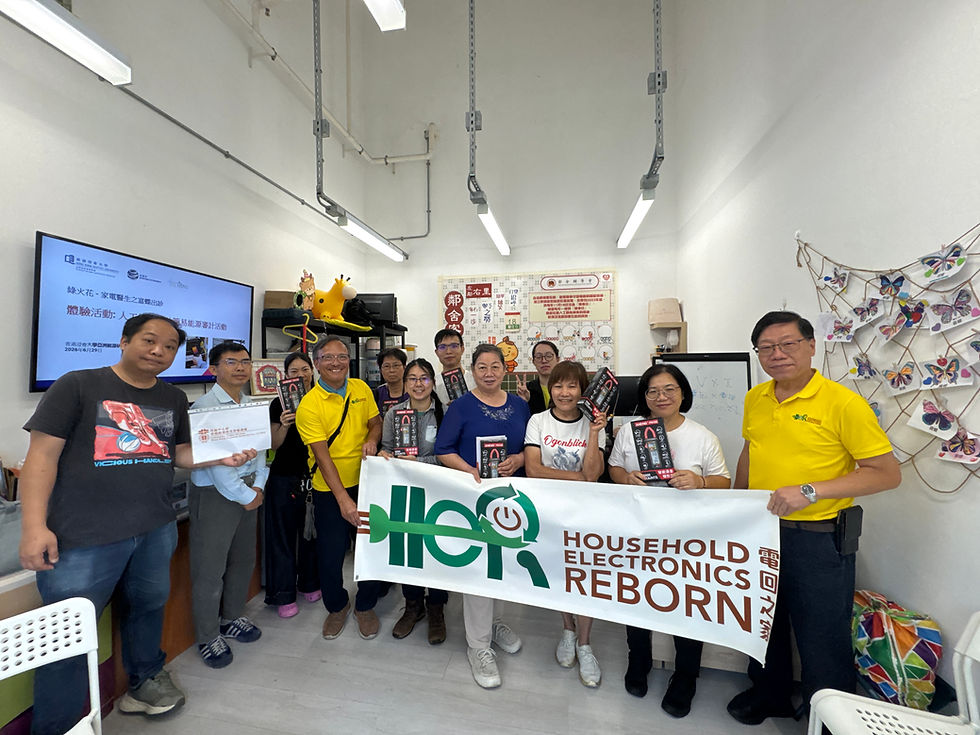
Group photo of Smart Energy Community STEM Workshop Autistic children playing the low-carbon games designed by BU students Autistic children experiencing VR game Students creating the with children to promote low carbon lifestyle
After the workshop, HKBU students visited the Yantian Residential District The Disabled Comprehensive Service Center to learn about local social welfare support for persons with disabilities.
In the afternoon session, the students visited the Zero-Carbon Park in Longgang District to explore low-carbon design in practice. The park demonstrates how features such as low-carbon landscaping, solar energy generation, sustainable architecture, and environmental education can be integrated into public space design. It also incorporates the “sponge city” concept, where rainwater is collected and reused.
Overall, the visit enabled HKBU students to deliver low-carbon knowledge to children with special educational needs in an interactive way, while also helping parents gain new insights into environmental education. At the same time, the students gained first-hand experience of zero-carbon design, enhancing their understanding of how low-carbon communities can be realised in practice.
Students visited the Comprehensive Service Center for the Disabled in Yantian District Students visited the waste treatment exhibition hall in Zero Carbon Park Group photo of visiting Zero Carbon Park Students gained an on-site understanding of the low-carbon design of the zero-carbon park


Comments